
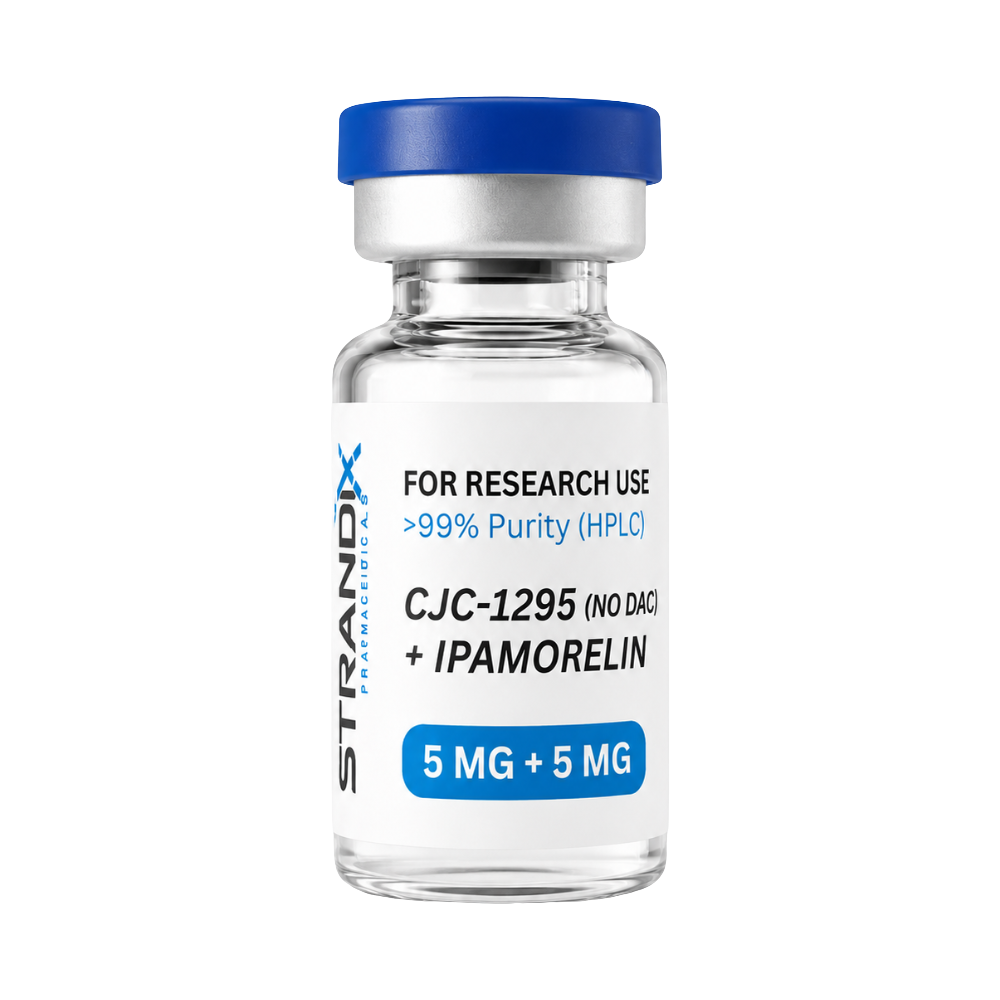
CJC-1295 (No DAC) / Ipamorelin
$59.99
In stockCJC-1295 No DAC and Ipamorelin is a dual-peptide research formulation containing 5 mg of modified GRF (1-29) and 5 mg of Ipamorelin.
| SKU | RC-ST-CJC-IPA-5MGBL |
|---|---|
| Manufacturer | Strandix Peptides |
| Form | Lyophilized Powder |
| Strength | 5 mg / 5 mg |
| Size | 3 mL Vial |
| Reported Result | Supplier spec pending verification |
| Stock | In stock |
| Documentation Status | Pending matching 5 mg / 5 mg COA |
This CJC-1295 No DAC and Ipamorelin blend combines two synthetic research peptides associated with separate regulatory points along the growth-hormone signaling axis. The formulation contains 5 mg of CJC-1295 without DAC and 5 mg of Ipamorelin, for a combined total of 10 mg of research peptide material.
Although both compounds have been investigated in relation to growth-hormone secretion, they are structurally distinct and interact with different receptors. CJC-1295 No DAC acts as an analog of growth hormone-releasing hormone, while Ipamorelin is a growth-hormone secretagogue that interacts with the ghrelin receptor. Neither compound is a SARM, anabolic steroid, or form of growth hormone.
CJC-1295 No DAC — 5 mg
“CJC-1295 without DAC” is the commercial name commonly applied to modified growth hormone-releasing factor 1-29, or modified GRF (1-29). This naming requires an important scientific distinction: the original CJC-1295 studied in human clinical research included a Drug Affinity Complex, or DAC, designed to bind circulating albumin and substantially prolong the peptide’s exposure. The no-DAC material does not possess that albumin-binding modification and should not be assigned the prolonged pharmacokinetic profile of DAC-linked CJC-1295.
Modified GRF (1-29) is a synthetic analog of the biologically active N-terminal portion of endogenous growth hormone-releasing hormone. Native GHRH is a hypothalamic peptide that communicates with somatotroph cells in the anterior pituitary. Its shorter 1-29 fragment retains the portion of the sequence responsible for receptor activation.
The modified peptide contains amino-acid substitutions designed to improve resistance to enzymatic degradation while preserving activity at the GHRH receptor. The GHRH receptor is a G-protein-coupled receptor primarily associated with the pituitary. Receptor activation can engage cyclic AMP, protein kinase A, intracellular calcium, and other signaling processes involved in regulated growth-hormone synthesis and release.
Unlike the DAC-linked form, modified GRF (1-29) is not engineered for covalent attachment to serum albumin. It is consequently regarded as a comparatively short-acting research analog. This difference is pharmacologically significant: findings from studies of long-acting DAC-linked CJC-1295 cannot be directly transferred to the no-DAC version.
Research specifically examining the pharmacokinetics, toxicology, and controlled clinical effects of the material sold as CJC-1295 No DAC is limited. Much of its scientific context is derived from broader research involving native GHRH, GHRH fragments, modified GRF analogs, and the structurally related—but pharmacokinetically different—DAC-linked CJC-1295.
Ipamorelin — 5 mg
Ipamorelin, also identified by the development code NNC 26-0161, is a synthetic pentapeptide growth-hormone secretagogue. Its amino-acid sequence is Aib-His-D-2-Nal-D-Phe-Lys-NH₂, incorporating nonstandard amino-acid components that influence receptor activity and enzymatic stability.
Ipamorelin’s primary identified target is the growth-hormone secretagogue receptor type 1a, or GHS-R1a. This receptor is more commonly called the ghrelin receptor because ghrelin is its principal endogenous ligand. It is a G-protein-coupled receptor expressed in the hypothalamus, pituitary gland, gastrointestinal system, and other tissues.
Ghrelin-receptor activation engages intracellular signaling pathways that can involve phospholipase C, inositol phosphates, protein kinase C, and changes in intracellular calcium. Within the hypothalamic-pituitary system, these pathways participate in the regulation of pulsatile growth-hormone secretion. Ghrelin-receptor biology is also connected to appetite, gastrointestinal motility, glucose regulation, reward signaling, and energy homeostasis, demonstrating that this receptor is not limited to a single endocrine function.
Early preclinical research characterized Ipamorelin as comparatively selective for growth-hormone-related signaling when evaluated against certain other pituitary hormones in experimental models. That experimental selectivity should not be interpreted as proof that Ipamorelin acts only within the pituitary, produces no off-target effects, or has an established safety profile in humans.
Ipamorelin is not growth hormone itself. It acts upstream through receptor-mediated signaling and remains an investigational peptide without an FDA-approved indication.
Storage and handling: Store unopened lyophilized blend according to the manufacturer label, protected from heat, light, and moisture. Avoid repeated temperature cycling. Do not assume that storage or reconstituted stability data for either individual component applies to the blend without product-specific validation.
Third-party testing status.
| Batch / Lot | Reported Result | Tested | Partner | Status | Document |
|---|---|---|---|---|---|
| N/A | Supplier spec pending verification | Pending | Pending | Pending matching 5 mg / 5 mg COA | Pending matching 5 mg / 5 mg COA |